Wednesday, November 15, 2017

PhD Thesis: SNAPSHOT PHOTOGRAPHY: A PHATIC, SOCIALLY CONSTRUCTED, MNEMONIC TECHNOLOGY - READ

Abstract

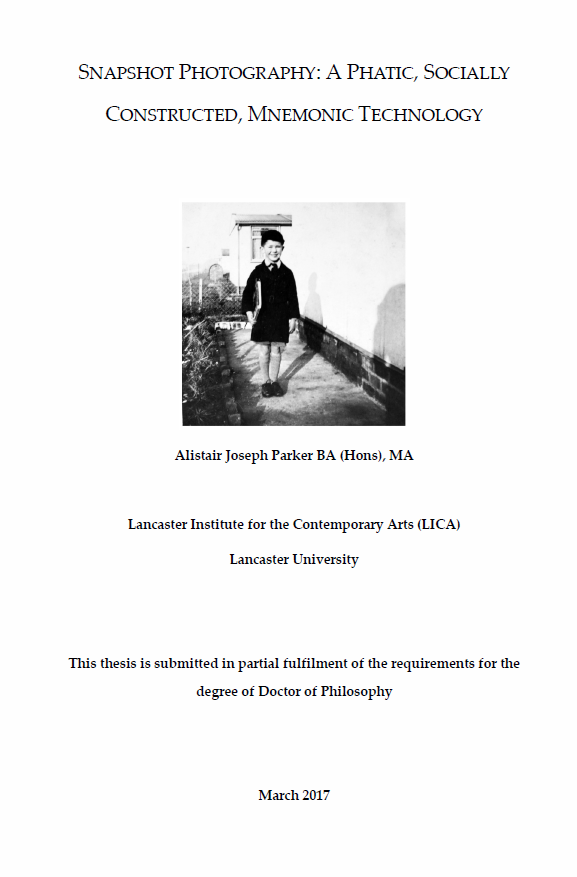
This practice related research study explores my cognitive response to a biographical snapshot photograph celebrating my first day at school. The experience triggered an exploration of the relationship between snapshot photographs and memory. The finding of a second almost identical snapshot photograph of my son taken twenty years later by me prompted me to question why my father and I should take almost identical snapshots.

I argue that the invention of photography was driven by the desire to capture the images created by the camera obscura by mark-making with the pencil of light as an aid memoir.

I argue that the desire to externalise memory using mnemonic technology is innate with primal origins in parietal art and lithic technologies. The discourse explores the cultural evolution of technology through Jaques Derrida’s theory of originary technicity and Bernard Stiegler’s concept of the cultural evolution of technology by epiphylogenesis and the notion of the externalisation of memory as prosthesis.

I explore the emergence of snapshot photography from the canon of photography through the theories of cultural evolution, technological momentum, and social constructivism, together with psycho-social notions of desire, ritual, performativity and intentionality in the establishment of snapshot photography as a ubiquitous ingrained social practice.

The research is informed by a studio practice element that uses the adventures of Lewis Carroll’s, Alice as a conceptual framework to explore a journey of agency, self and auto didactical knowledge acquisition. I discuss the search for an appropriate methodological framework for art practice based research.

My practice is a catalyst for enquiry; a project usually starts with an artefact that forms the locus of a question, the search for the answer to those questions, often leading epistemically, to unexpected places and relationships. The mode and manner of my enquiry are rhizomatous, pragmatic and serendipitous; the relationship between practice and theory is flexible, one informing the other.

Through practice, I explore the deconstruction and textualisation of the visual metaphor of memory through the rhetorical devices of ekphrasis and memory texts and a visualisation of the nature and originary technicity of snapshot photography and an exploration of self and place.

The thesis for this study is founded on the premise that snapshot photography is a socially constructed, phatic, mnemonic mark-making technology with origins in parietal forms of visual expression.

Thesis Download Links

 UPDATE: 23 August 2020

The former link to my Thesis is no longer available, here are alternative links to the completed Thesis and the Powerpoint Presentation of the exhibition that was part of my practice related research

Link the Lancaster University Research Directory page http://www.research.lancs.ac.uk/portal/en/publications/snapshot-photography(82923ac2-44bd-4800-9be3-191d9f63f802).html

Link to the PhD Thesis PDF document file 
http://www.research.lancs.ac.uk/portal/services/downloadRegister/201945481/Parker2017phd.pdf

Link to the  Powerpoint Presentation of the accompanying Exhibition  
http://www.research.lancs.ac.uk/portal/services/downloadRegister/201945483/PhD_Exhibition_Presentation.pptx


Friday, April 14, 2017

PhD Thesis - Viva Voce

 Snapshot Photography: A Phatic, Socially Constructed, Mnemonic Technology

I survived my Viva Voce on the 13th March and was awarded a PhD subject to minor amendments and corrections. As soon as these have been completed I shall post a copy of the Thesis on the blog.


Tuesday, November 8, 2016

Large space before footnotes in MS Word 2010: Quick Fix

Formatting and Style problems are the one of the most time consuming aspects of thesis writing. Finding solutions to problems seems to take forever. Here is another problem that took me ages to sort out. I am using Word 2010, the solution is slightly different in other versions.

The problem is large spaces at the end of pages which are not cured by adjusting Paragraph settings. The problem proved to be associated with Footnote formatting. But finding out how to make the adjustment would try the patience of a saint.

The problem looks like this...


Check out this link for a solution on the Jess Writes Words blog...

LINK

Wednesday, November 2, 2016

Finishing the P.h.D. - Restructuring

Pat Thompson in her latest blog post hit the nail on the head. I quote:
You’ve done your thesis plan. You’ve written for weeks. And weeks. But now, despite your very best planning,  you find yourself at a point where that carefully thought out thesis road map no longer seems to work. This apparent catastrophe may happen before the first draft of the thesis is finished, it may be at the end of a second or third draft.
This is exactly where I am at, 3 years in 2 months to go to the deadline for my hand-in and here I am shuffling 50+K words. Mine is a practice-based thesis, 60:40 words: practice, hence the word count.

Pats' post came at just the right moment, providing much needed reassurance that I was doing the right thing.

I have joked for some time that I had all the right words, they were just not necessarily in the right order; to misquote UK comedian Eric Morecambe.

Source link

Tuesday, November 1, 2016

Improve Your Writing

Check out Bristol Universities excellent Improve Your Writing web pages...


Source http://www.bristol.ac.uk/arts/exercises/grammar/grammar_tutorial/index.htm

Sunday, October 2, 2016

Poem: Fragments of Memory with Video


Fragments of Memory

Standing still
A special day
The place I know
The path beside the house
The coal shed
The house next door
Me, my face, my hands
My legs, my shoes
My book My cap
The gabardine raincoat
Keeps me warm and dry
Me ready for school
The path, the bricks along the edge
The shadows
Heavy on the wall
Me, my dad, together
I remember the place
But not the day


An element from my PhD Thesis Exhibition of Studio Practice


Grammarly | Instant Grammar Check - Update #2

UPDATE #2 I previously blogged a post about Grammarly - a Grammar Checker plug-in for Word, on 15 February 2015 when I mentioned that I had uninstalled this Grammar Checking app after personal bad experiences and poor reviews elsewhere. link

However, they seem to have updated the previous version and the Word plug-in is now FREE, it does not enjoy as many functions as the paid-for option. I used it to proof my Ph.D. Thesis, 60k words and it nearly made it to the end. There seems to be a limit on how many edits it will allow in the semi-automated mode. I finished the job of manually but I suppose it did about 50K words before that happened. I have not looked into the issue at this stage because I don't have the time. But it did pick up some interesting stuff but it is slightly more dyslexic in some areas than I am. But that was OK because it was consistent and I just ignored the suggestions. Would I pay for it? No, I don't think so but if you can cope with the minor limitations of the free version I would suggest it is worth a try. There is also a free plug-in for Chrome which I am trying.
If you want to check out the reviews I suggest you Google them, there are too many to list here.

Friday, September 30, 2016

The Croods - The Invention of the Snapshot

From the animated movie The Croods a family drama set in the Stone Age, a parody of Plato's Cave. After their cave is destroyed, the stone age family must trek through an unfamiliar fantastical world with the help of an inventive boy Grug. Here we see his efforts at inventing snapshot photography.

The Croods tells the story of the world's first family road trip. When their cave is destroyed, the Crood family must embark on a comedy adventure into strange and spectacular territory in search of a new home. As if patriarch Grug (Cage) didn't already have enough to handle, it goes from bad to worse when they encounter an imaginative nomad named Guy (Reynolds.) With Guy's help the Croods conquer their fear of the outside world and discover that they have exactly what it takes to survive - each other.(c) 

The first snapshot photograph


Wednesday, August 3, 2016

Rhizome


Published on 30 Oct 2014
Video 1 in the Three Minute Theory series presents a primer on Gilles Deleuze and Felix Guattari's concept of "the rhizome."

Like what you see? Like us on Facebook: http://on.fb.me/1NIp896

Video Written & Created by: Stacey Kerr, Erin Adams, & Beth Pittard

Music from: Dustin Brian Kennedy https://soundcloud.com/dustinbrianken...

Thursday, July 21, 2016

WHY IS ACADEMIC WRITING SO ACADEMIC?

Re-post of an article by Joshua Rothman in the The New Yorker

A few years ago, when I was a graduate student in English, I presented a paper at my department’s American Literature Colloquium. (A colloquium is a sort of writing workshop for graduate students.) The essay was about Thomas Kuhn, the historian of science. Kuhn had coined the term “paradigm shift,” and I described how this phrase had been used and abused, much to Kuhn’s dismay, by postmodern insurrectionists and nonsensical self-help gurus. People seemed to like the essay, but they were also uneasy about it. “I don’t think you’ll be able to publish this in an academic journal,” someone said. He thought it was more like something you’d read in a magazine.

Was that a compliment, a dismissal, or both?

More...

The Needless Complexity of Academic Writing

A new movement strives for simplicity.

Re-post of an article in The Atlantic by Victoria Clayton

The idea that writing should be clear, concise, and low-jargon isn’t a new one—and it isn’t limited to government agencies, of course. The problem of needlessly complex writing—sometimes referred to as an “opaque writing style”—has been explored in fields ranging from law to science. Yet in academia, unwieldy writing has become something of a protected tradition. Take this example:

The work of the text is to literalize the signifiers of the first encounter, dismantling the ideal as an idol. In this literalization, the idolatrous deception of the first moment becomes readable. The ideal will reveal itself to be an idol. Step by step, the ideal is pursued by a devouring doppelganger, tearing apart all transcendence. This de-idealization follows the path of reification, or, to invoke Augustine, the path of carnalization of the spiritual. Rhetorically, this is effected through literalization. A Sentimental Education does little more than elaborate the progressive literalization of the Annunciation.
More...


Passive Resistance

The active voice isn’t always the best choice.

Re-post of an article in The Atlantic by Steven Pinker
The passive voice has long been dismissed as a hallmark of turgid prose. “Many a tame sentence,” wrote Strunk and White in The Elements of Style, “can be made lively and emphatic by substituting a transitive in the active voice for some such perfunctory expression as there is, or could be heard.” George Orwell, in “Politics and the English Language,” agreed: among the “tricks by means of which the work of prose construction is habitually dodged” is that “the passive voice is wherever possible used in preference to the active.”
More... 

21st July 2016

Sunday, June 19, 2016

Practice as Research - Literature

  • Visualizing Research: A Guide To The Research Process In Art And Design

  • Authors - Carole Gray, Julian Malins
  • Publisher - Ashgate Pub Ltd
  • ISBN - 9780754635772
  • Date - December 31, 2004
  • Abstract
  • Visualizing Research guides postgraduate students in art and design through the development and implementation of a research project, using the metaphor of a 'journey of exploration'. For use with a formal programme of study, from masters to doctoral level, the book derives from the creative relationship between research, practice and teaching in art and design. It extends generic research processes into practice-based approaches more relevant to artists and designers, introducing wherever possible visual, interactive and collaborative methods. The Introduction and Chapter 1 'Planning the Journey' define the concept and value of 'practice-based' formal research, tracking the debate around its development and explaining key concepts and terminology. 'Mapping the Terrain' then describes methods of contextualizing research in art and design (the contextual review, using reference material); 'Locating Your Position' and 'Crossing the Terrain' guide the reader through the stages of identifying an appropriate research question and methodological approach, writing the proposal and managing research information. Methods of evaluation and analysis are explored, and finally strategies for reporting and communicating research findings are suggested. Appendices and a glossary are also included. Visualizing Research draws on the experience of researchers in different contexts and includes case studies of real projects. Although written primarily for postgraduate students, research supervisors, managers and academic staff in art and design and related areas, such as architecture and media studies, will find this a valuable research reference. An accompanying website www.visualizingresearch.info includes multimedia and other resources that complement the book.


Friday, March 18, 2016

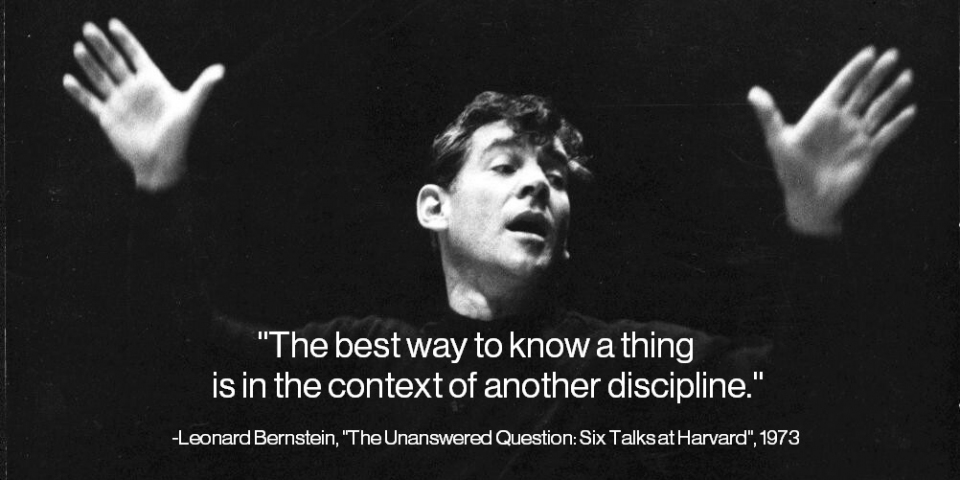
ARTFUL LEARNING® stimulates and deepens academic learning through the arts

Link: https://leonardbernstein.com/artful-learning

Hero Image

Artful Learning is a transformational learning model that empowers educators to use the arts and the artistic process to awaken and sustain the love of learning for all students. Based on over twenty years of intensive collaboration and refinement, field research and implementation with leading educators, researchers and practitioners of the model, the Artful Learning Sequence and Model is a framework that educators can use to revitalize their curriculum and their teaching practice.

Grounded in the artistic process, this extensive, research-proven professional development program gives educators the tools to apply the Artful Learning methodology over a three-year implementation process, ultimately building a sustainable, thriving learning community.

Initiated by American music icon Leonard Bernstein and realized by thousands of people around the nation, Artful Learning is changing the landscape of teaching and learning. Bernstein's vision was to use music and the other visual and performing arts as a means of instilling a lifelong love of learning in students. Artful Learning embeds the arts within the learning process through a carefully researched, concept-based, interdisciplinary model that has proven to increase comprehension in students as well as improve academic achievement.

https://vimeo.com/196328075

The Artful Learning Model (narrated by Alexander Bernstein) from The Leonard Bernstein Office on Vimeo.


Wednesday, October 14, 2015

What is Critical Thinking

When I started my BA in Fine Art the subject area I found interesting but baffling was Critical Studies. No one really explained to me what CS was about, to me it was a mix of contextual studies and art history with a bit of philosophy thrown in. No one really explained that it was all about Critical Thinking but what is Critical Thinking?

Here is one definition:-
Critical thinking is the ability to think clearly and rationally. It includes the ability to engage in reflective and independent thinking. Someone with critical thinking skills is able to do the following: understand the logical connections between ideas. Link

And another:-

Critical thinking is the process we use to reflect on, access and judge the assumptions underlying our own and others ideas and actions. Link

Ok, that's the what and the why how about the how? As is so often my experience in education you are told what and why but never how. How do you think reflectively and independently?

Well a BA, an MA and half a PhD further down the learning road I think I may have found the answer: Socratic Questioning!

What is Socratic Questioning? To answer the question the best place to start is my favourite PhD mentoring Blog, The Thesis Whisperer where Dr Inger Mewburn, Director of research training at the Australian National University, doles out words of wisdom and support for flagging PhD students. Link

Thursday, May 28, 2015

Zotero Support: How to back up your Zotero library

I nearly had a heart attack this morning when I thought I had lost my Zotero database after resetting Firefox to its default settings. However fortunately it synced to the online backup and all was well but it made me realise that it was a long time since I had done a local backup. Here is a useful link from the Zotero website to guide you through the process of making a  backup.

This link is taken from the Zotero website, click the link or the image to go directly to the page...

  1. To back up your Zotero library you will need to locate the Zotero data directory where your Zotero data is stored on your computer. To do this click on the actions button (gear icon) in the Zotero toolbar and select preferences:


Wednesday, April 15, 2015

First Day at School Photograph - PhD Project

First Day at School Photomicrograph and Legend on Verso

If the information written on this photograph is correct this is a snapshot of me aged 9 in school uniform taken on the occasion of my first day at school. The photograph was found in one of my mothers many photograph albums. The above reproduction of the photograph shows a caption on the reverse of the photograph in her handwriting.

I am shown standing alongside the Prefab in which we had lived since 1947.The Prefab was on the Belle Vale estate on the edgelands of Liverpool between Childwall and Woolton. The estate of 1500 prefabricated buildings was built to replace the housing stock destroyed during the war. They were intended to house families with one or more children. We are about to move house to Allerton and I was about to move schools.

This photograph is the basis of my art practice research based PhD thesis. My research is concerned with the snapshot photograph and its relationship with memory. The thesis endeavours to answer the question, why do we take snapshots. I am using this photograph as a lens through which to explore this question.

My research is based on an exhibition which takes this photograph as its central theme. Part of the exhibition explores the snapshot pose as represented in this photograph. I am interested in the banality and repetition of the pose in such snapshots and I am curious to understand if there is a fundamental reason why, as individuals, we take such similar snapshots.

I have set up a Facebook page with a view to collecting together at least 50 photographs that reflect the theme "First Day at School". These photographs, with the owners permission, will be used as the basis for an installation within my exhibition.

I hope that people will participate in the project by digging into their shoe boxes, albums and on-line archives to send me copies of snapshots of themselves, offspring, family and or friends, taken on their" First Day at School", or any similar photograph.

I have created a Facebook page specifically for this project. Photographs may be posted on the Project page or your Facebook page or they may be sent via a personal message or as an email attachment.

Wednesday, April 1, 2015

PhD Exhibition Draft Proposal

Mock up of Exhibition Space as Camera Obscura

YouTube Video of the Camera Obscura idea for the Exhibition


The video show a simulation of a moving scene of the exterior view from the exhibition space projected by means of a lens embedded in a blanked out window onto the opposite wall of the room to simulate a Camera Obscura. In reality the movement in the image would be limited to people walking past and any movement in the foliage.

The concept behind the installation is a simulation of the originary technicity of the photograph when Henry Fox Talbot viewed the scene of Lake Como from the balcony of his hotel room on the screen of his portable Camera Obscura and dreamt of a way of fixing the image he saw by capturing the light or by painting with the light as he put it. His sole intention being to remember the spectacular view and to be able to share it with others on his return home. The originary moment is contrasted with the reality of his dream, the banal snapshot photograph. Which is represented here by the negative space of a classic snapshot pose, "The first day at school" snapshot.

Monday, March 30, 2015

"The Wayback Machine" - Archive.org - a resource you should be aware of...

https://archive.org/

Internet Archive is a non-profit library of millions of free books, movies, software, music, and more...

The Internet Archive also known as "The Wayback Machine" is a San Francisco-based non-profit digital library with the stated mission of "universal access to all knowledge". It provides free public access to collections of digitized materials, including websites, music, moving images, and nearly three million public-domain books. As of October 2012, its collection topped 10 petabytes. In addition to its archiving function, the Archive is an activist organization, advocating for a free and open Internet.